Nobu arranges Sayuri’s wartime refuge
Memoirs of a GeishaNobu arranges Sayuri’s wartime refuge by securing her a place with his friend Arashino Isamu, a kimono maker whose riverside home also serves as his workshop. The offer is both practical rescue and a charged reckoning: Nobu can provide a haven, but first demands that Sayuri acknowledge the hurt between them. The arrangement carries her from Gion into years of labor and deprivation, and leaves her feeling increasingly indebted to him.
The offer and its condition
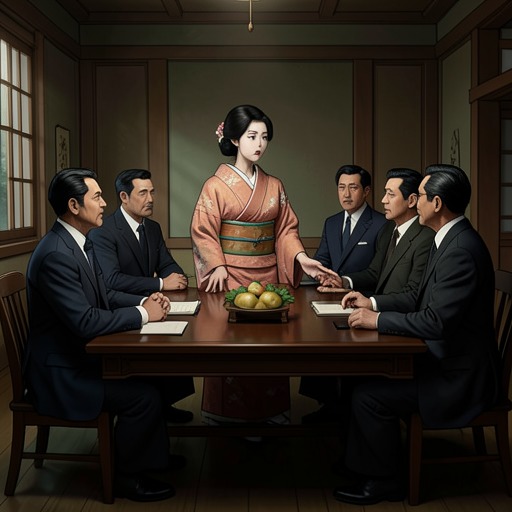
Nobu meets Sayuri after more than four years apart and tells her that he has saved his influence for her. He can protect her from the factories and has access to what he calls a perfect haven, but he refuses to provide it until she bows before him and admits she was wrong about what happened four years earlier. His anger is bound up with disappointment: he says that she brushed him aside and spent the ripest years of her life on a fool who will not pay even the debt he owes his country. The refuge therefore arrives not as uncomplicated charity but as help entangled with old grievance and a demand for contrition.
Sayuri has feared that Nobu would be angry with her, and his forceful words make her struggle not to cry. She recognizes that he may want her tears, but the grief soon exceeds the immediate dispute: she cries for Nobu and herself, for the uncertain future, and for General Tottori and Korin, whose life in the factory has left him gray and hollow. Then she does what Nobu demanded. She moves away from the table to make room and bows low to the floor. The physical gesture resolves the immediate condition of his offer, while the tears register how much more than a personal misunderstanding is at stake.
The Arashino refuge
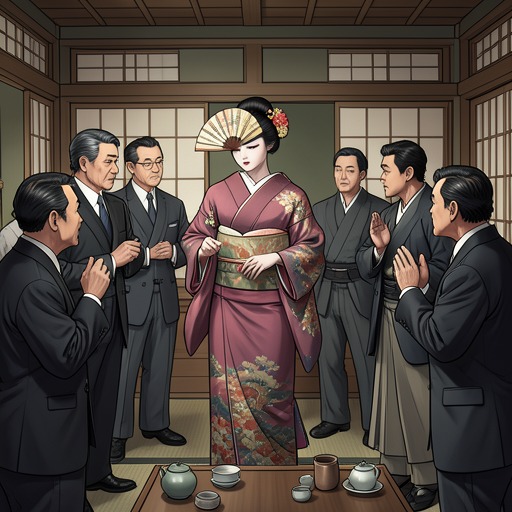
Nobu explains that the haven is the home of his friend Arashino Isamu. The house and workshop stand by the shallow banks of the Kamo River, about five kilometers upstream from Gion. Arashino and his wife and daughter had formerly made the Yuzen-style kimono for which he was known; wartime demand has redirected their silk-working skills toward sewing parachutes. Nobu tells Sayuri that she can learn the work quickly and that the family is willing to take her in. He will make the necessary arrangements with the authorities.
He makes the offer tangible by writing Arashino’s address on a piece of paper and handing it to Sayuri. She thanks him repeatedly, and each time he looks more pleased with himself. A possible walk together in the newly fallen snow never takes place: Nobu checks his watch and drains the last of his beer. Before they part, he tells her that he does not know when they will meet again or what the world will be like then, but that he will think of her whenever he needs reminding that beauty and goodness remain in the world. His farewell places tenderness beside the practical arrangement, without erasing the anger that preceded it.
From shelter to wartime labor
The need for Nobu’s intervention becomes clearer in the following account: hundreds of geisha in Gion are struggling to find a wartime nest, and only a few succeed. Sayuri understands that her refuge is not an opportunity that another admirer would necessarily have supplied; she feels more deeply in Nobu’s debt with each day she lives with the Arashino family. The arrangement thus changes her immediate prospects while strengthening an obligation already complicated by their estrangement.
The Arashinos treat Sayuri kindly, but shelter does not mean comfort. By day she works with them sewing parachutes; at night she sleeps beside their daughter and grandson on futons spread across the workshop floor. With charcoal scarce, they burn compressed leaves, newspapers, and magazines for warmth. Food becomes scarcer still. They eat soybean dregs normally given to livestock and nukapan, made by frying rice bran in wheat flour, as well as occasional potatoes and sweet potatoes, dried whale meat, seal sausage, and sardines. Sayuri grows so thin that people on Gion’s streets would not recognize her.
The family’s dwindling resources make each kimono sale a response to immediate hunger. When the Arashinos’ grandson Juntaro cries from hunger, Arashino generally decides to sell one from his collection. Sayuri describes this erosion as an onion life: layer by layer, a person is stripped of what remains, crying all the while. The phrase gives the refuge’s daily economy a form: a place secured through Nobu’s influence becomes a place where survival depends on labor, improvisation, and the gradual liquidation of the family’s treasured work.
Narrative significance
The refuge is a rescue with costs rather than a simple escape from danger. Nobu’s influence grants Sayuri access to a household and a livelihood at a moment when Gion’s geisha are competing for scarce shelter; in return, his demand for an apology makes personal indebtedness part of the arrangement. The story follows the offer beyond the address on a piece of paper to the workshop floor, the parachutes, and the food shortages, showing what survival in that haven entails.
The episode also turns the image of a nest into a measure of wartime vulnerability. Nobu presents the home as a safe haven, but it cannot insulate Sayuri or the Arashinos from hunger, cold, or the larger uncertainty of war. Its significance lies in the combination: a concrete act of protection, a renewed but uneasy bond between Nobu and Sayuri, and years of shared work through which the cost of being sheltered becomes visible.